|
¶SPHEREx. NASA’s optical and infrared Spectro-Photometer for the History of the Universe, Epoch of Reionization, and Ices Explorer, more concisely referred to as SPHEREx, is scheduled to launch next week on the Falcon 9 that will also deliver PUNCH (c.f. Issue 304). This SSO-orbiting space telescope will provide the first all-sky IR spectral survey, peering through dust and collecting data on 450 million galaxies up to 10 billion light-years away in 102 different color bands, as well as observing 100 million stars in the Milky Way. While JWST picks and chooses targets, SPHEREx will survey the full sky every six months. Spectrographic data on stars will look for signs of water and organic molecules, while galactic data will help us understand inflation and the epoch of reionization, as well as the history of galaxy formation and our galactic neighborhood. The mission’s instrument is a spectrophotometer with six linear variable filters, demonstrated on New Horizons, and six HgCdTe photodetector arrays, all protected and kept passively cold by three concentric conic ‘photon shields,’ giving the telescope a distinctive look and allowing it to have no moving parts once its deployables are unfurled on orbit. SPHEREx will also be useful much closer to home, potentially detecting many new Near-Earth Objects, including potentially hazardous ones, with a sensitivity comparable to NASA’s very successful NEOWISE mission but with more spectral bands for characterizing detected objects (paper). With all the hubbub around 2024 YR4, it feels like a timely launch.
|
|

|
|
SPHEREx at a pre-launch rave.
|
|
|
The Orbital Index is made possible through generous sponsorship by:
 
|
|
|
¶Regional space activities (part II): Africa 🌍. Eighteen of the 54 UN-recognized countries in Africa have national space agencies: Algeria, Angola, Egypt, Ethiopia, Gabon, Ghana, Kenya, Libya, Malawi, Mauritius, Morocco, Nigeria, Rwanda, Senegal, South Africa, Sudan, Tunisia, and Zimbabwe. Agencies are also expected to be established in Botswana, Djibouti, Namibia, and the Republic of Côte d'Ivoire in the near future, and 20+ African nations participate as members of the UN Committee on the Peaceful Uses of Outer Space. Headquartered in Cairo, the African Space Agency (AfSA) completed its inauguration by the African Union (AU) in 2023 to facilitate regional cooperation, boost the space sector in Africa, ensure optimal access to space services, and prevent duplication of efforts (the AU also has six guiding space policy principles and nine space strategy action areas). Over 60 satellites have been launched for 17 African countries since 1998—Egypt and South Africa leading the continent in this regard. Africa’s equatorial latitudes and eastern seaboard adjoining the Indian Ocean present appealing locations for safe and efficient launch sites, and multiple were actively developed by European nations following WWII. Currently, the continent has five (or six) inactive rocket launch sites (with another, the San Marco Launch Platform, under planned redevelopment). While African countries have tended to invest in the utilization of space rather than the creation of their own launch infrastructure, one clear exception regarding African self-development is the Denel Overberg Test Range in South Africa, which has been used for testing missiles since the 1980s. According to the African Astronomical Society, there are 36 observatories across the continent, including SALT (below). As Africa’s space programs and facilities continue to expand, countries’ interest in international cooperation is also growing. So far, Angola, Nigeria, and Rwanda have all signed the Artemis Accords, while Egypt, South Africa, and Senegal have joined China’s International Lunar Research Station. In 2021, Türkiye proposed the development of a spaceport in Somalia, and purportedly, the construction began in December 2024. In 2023, Djibouti signed a memorandum of understanding with Hong Kong Aerospace Technology Group to construct a site with seven satellite launch pads and three rocket testing pads valued at $1B over a five-year period in the northern Obock Region. There are also numerous Africa-based international space communications facilities, including China’s BeiDou center in Tunisia, the newly installed European Meteosat receiving stations in Kenya, and NASA’s Lunar Exploration Ground Sites (LEGS) antenna and Russia’s space debris monitoring system in South Africa. As of 2024, there were 320+ African commercial space-related companies tallied by Space in Africa, the predominant source of regional space information. — Part I of this series, focused on South America, ran back in Issue № 284.
|
|
|
Support Us› Orbital Index is made possible by readers like you. If you appreciate our writing, please support us with a monthly membership!
|
|
¶News in brief. The JWST will study Asteroid 2024 YR4 to help refine its orbit and size (the current size estimate is 40-90 m which leads to a wide variety of impact outcomes) ● A rover developed by Pakistan’s Space and Upper Atmosphere Research Commission (SUPARCO) will fly on China’s Chang’e-8 mission to the Moon’s south pole in 2028 ● Another rover exploring the Moon’s south pole will be Astrolab’s FLIP rover, which will fly on Astrobotic’s upcoming Griffin-1 mission, replacing VIPER ● Japan’s SKY Perfect JSAT was revealed as the customer that recently paid Planet $230M to build and operate 10 LEO satellites for 7 years ● New Glenn’s upper stage, in a 2,400×19,300 km orbit, appears to have broken up in space, creating 65+ pieces of debris that won’t deorbit any time soon, likely due to a passivation failure ● Blue Origin reduced their workforce by 10% (roughly 1,400 employees) to cut costs while focusing on ramping New Glenn launches (the second New Glenn is notionally launching in late spring, although one source says October is more likely) ● LA-based startup K2 Space raised a whopping $110M Series B to accelerate the development of their affordable, high-capacity satellite bus ● Boeing, the primary contractor for SLS, is preparing for layoffs ahead of a hypothosized Trump-and-Elon SLS cancellation ● NASA meanwhile released a statement stating that the SLS is ‘essential’ to Artemis ● SpaceX’s Starbase may become an incorporated city in South Texas after Cameron County approved an election in May, with votes only being cast by residents living near the launch site ● China conducted the first launch of the Long March 8A, carrying the second batch of satellites for the secretive national Guowang project ● MDA Space won a $768.1M contract from Globalstar (backed in part by Apple) to build 50+ AURORA comm satellites for a new LEO constellation ● South Korea’s Aerospace Research Institute (KARI) successfully developed and terrestrially-deployed a 10 m solar sail ● SpaceX flew a first stage Falcon 9 booster for the 26th time, breaking yet another reuse record ● Firefly’s Blue Ghost 1 entered lunar orbit, while iSpace’s Resilience lander conducted another lunar flyby (it is following a lower energy lunar trajectory).
|
|

|
|
Blue Ghost 1 in orbit around the Moon. Landing is scheduled for March 6th. Credit: Firefly Aerospace
|
|
¶Etc.
- “Airbus has hired Goldman Sachs Group Inc. for advice on an effort to forge a new European space and satellite company that can better compete with Elon Musk’s dominant SpaceX.” That seems… unlikely to work.
- Through incentivized resignations and now firing of “probationary” workers, the Trump administration has already cut NASA’s workforce by about 10%. This strategy seems unwise, as many probationary workers are new hires who may have brought fresh ideas to the agency.
- There is evidence that some geologic structures on the Moon may be much younger than previously thought. They may have formed as the Moon slowly shrank and shifted orbit over time.
- Relatedly, results from Chang’e 5 found evidence of lunar volcanism occurring only 120 million years ago, and results from Chang’e 6 suggest that the Moon’s magnetic field lasted longer than we thought. Our understanding of our nearest neighbor continues to evolve.
- In a first for space cuisine, ESA astronaut Sławosz Uznański-Wiśniewski will bring pierogis (Polish dumplings) to the ISS during the upcoming Axiom Mission 4.
- Inspiration4 contributed data to a new study on spaceflight and frailty that analyzed its impact on astronauts and mice. “Spaceflight induced notable changes in gene expression patterns related to frailty and muscle loss indicative of a frailty-like condition. Exposure to the space environment leads to changes related to inflammation, muscle wasting, and other age-related features observed in both mice and humans.” Not super great if you’re planning for a 10-14 month Mars transit time, although spinning the spacecraft would help.
- On a related note, here’s an exploration/analysis of the shortest hypothetical Mars transit time for Starship (with very liberal use of refueling throughout its flight).
- NASA released its 2024 State-of-the-Art Small Spacecraft Technology report.
- A 3D visualization, based on simulations, of the jets from a binary neutron star merger, which results in the “prompt” formation of a black hole (in this case, well within the 1.5-second simulation timeframe). Magnetorotational instability during the collapse drives a dynamo, which produces energetic jets, the likely source of gamma-ray bursts. These simulated jets would emit 1042 joules/second—that’s ~100,000x brighter than all of the Milky Way combined (paper). Warning: Do not look directly into the gamma-ray burst with remaining eye/civilization.
|
|
|
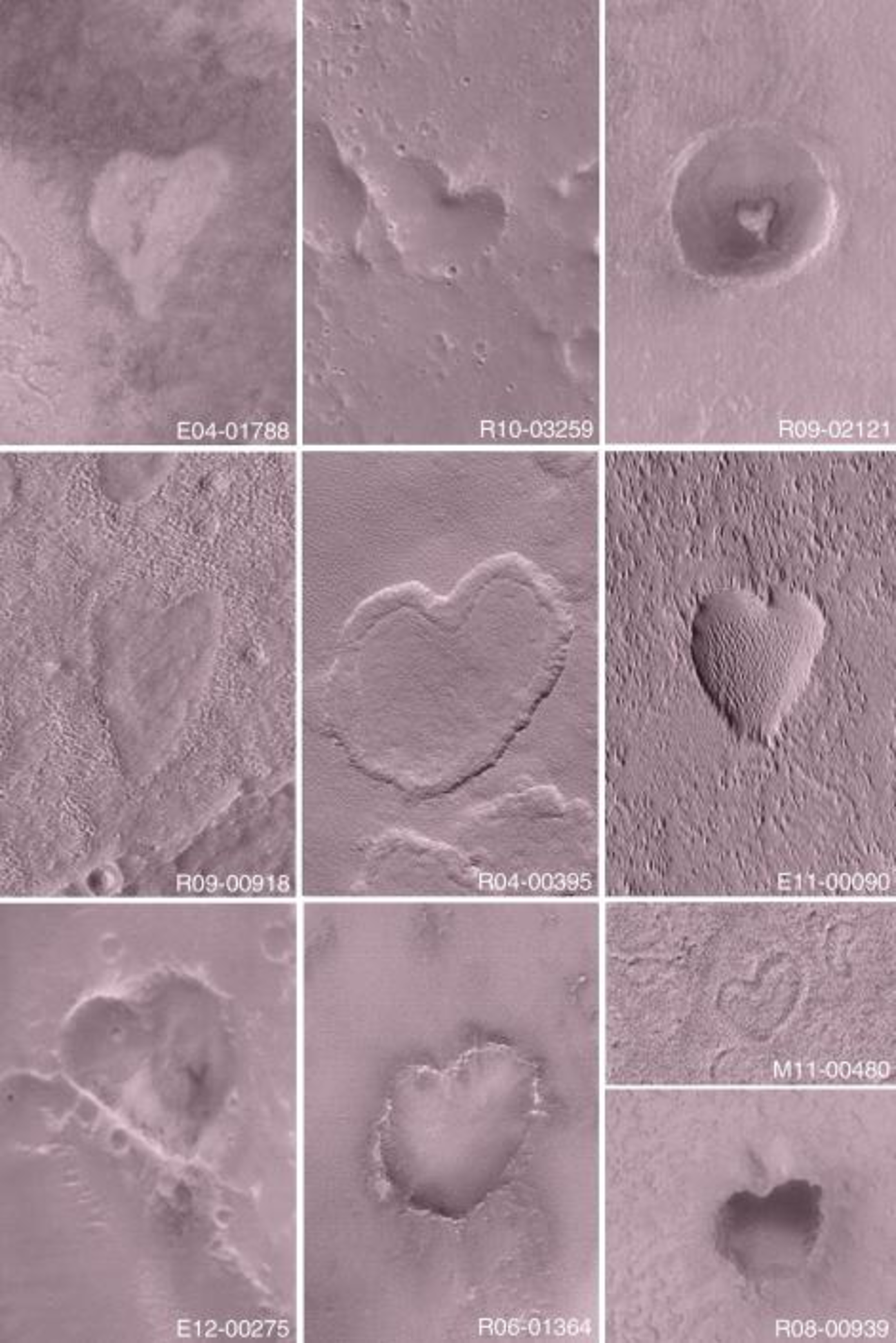
Happy belated Valentine's Day, dear readers! In 2004, the Mars Global Surveyor camera team shared this lovely collection of heart-shaped features on Mars. (We assume that these days, embedding-based geospatial searches could quickly identify hundreds more… if anyone wants a project.)
|

|
|
|